Author: Tushita Gupta ACCA
Are you planning your next ACCA exam attempt and wondering which ACCA papers have the highest pass rates? Or have you recently received your results and want to understand how your performance compares with the global figures?
Understanding ACCA paper pass rates can help you make informed decisions about exam preparation, identify papers that may require additional practice and develop a more effective study strategy.
The Association of Chartered Certified Accountants (ACCA) publishes exam pass rates after examination sessions. These figures show the percentage of candidates who passed each paper in a particular session. They can provide useful context, but they do not predict an individual student’s result.
This guide covers the latest official June 2026 pass rates, the highest and lowest pass rates by paper, historical comparisons, preparation advice and how BeingACCA resources can support students preparing for their next attempt.
Last reviewed: 18 October 2026. Figures shown below relate to the June 2026 session and should be refreshed when ACCA publishes a newer official table.
Official source: ACCA June 2026 results and pass rates
Latest ACCA Paper Pass Rates for June 2026
The official June 2026 results show meaningful variation across the ACCA Qualification papers. BT recorded the highest pass rate among the main qualification papers at 89%, while AAA recorded the lowest at 39%.
| Paper | Full paper name | Level | June 2026 pass rate |
| BT | Business and Technology | Applied Knowledge | 89% |
| MA | Management Accounting | Applied Knowledge | 65% |
| FA | Financial Accounting | Applied Knowledge | 71% |
| LW | Corporate and Business Law | Applied Skills | 82% |
| TX | Taxation | Applied Skills | 55% |
| FR | Financial Reporting | Applied Skills | 52% |
| PM | Performance Management | Applied Skills | 41% |
| FM | Financial Management | Applied Skills | 48% |
| AA | Audit and Assurance | Applied Skills | 47% |
| SBL | Strategic Business Leader | Strategic Professional | 51% |
| SBR | Strategic Business Reporting | Strategic Professional | 47% |
| AFM | Advanced Financial Management | Strategic Professional option | 47% |
| APM | Advanced Performance Management | Strategic Professional option | 42% |
| ATX | Advanced Taxation | Strategic Professional option | 47% |
| AAA | Advanced Audit and Assurance | Strategic Professional option | 39% |
Source: ACCA’s official June 2026 results announcement. Always check the official page for the latest available session.
Read the official figures: ACCA June 2026 pass rates
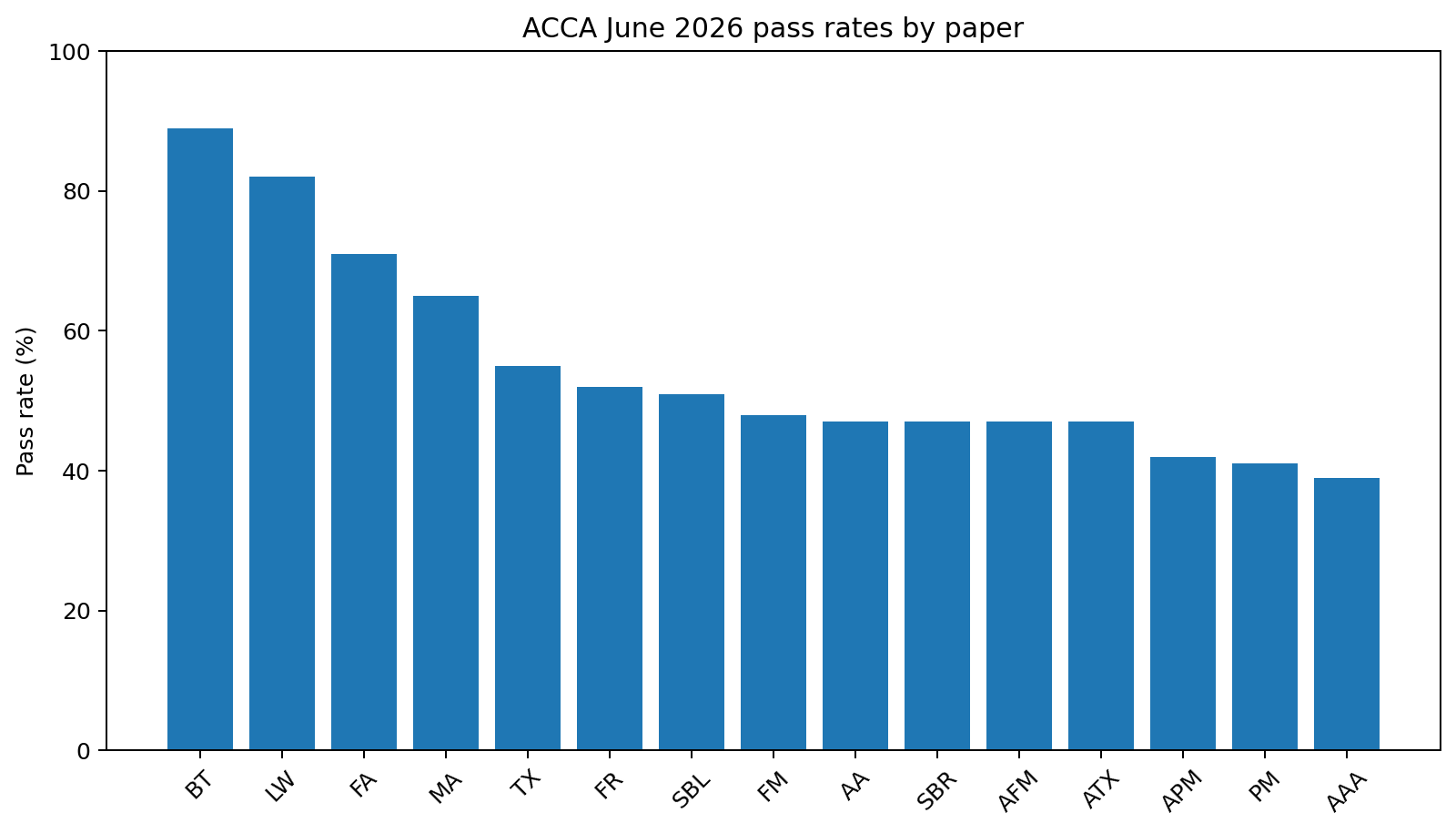 Figure 1. Official June 2026 pass rates for the main ACCA Qualification papers.
What Do ACCA Pass Rates Mean?
An ACCA pass rate is the percentage of candidates who passed a specific examination in a particular session. If a paper has a 41% pass rate, around 41 out of every 100 candidates who sat that paper passed in that session.
The pass rate is not the same as the pass mark. The standard pass mark for ACCA examinations is 50%, while the pass rate describes the proportion of candidates who achieved a pass.
- A pass rate describes a group of candidates, not an individual student’s likelihood of passing.
- Pass rates may change from one exam session to another.
- A lower pass rate does not mean that passing is out of reach; preparation, practice and exam technique matter.
Which ACCA Paper Has the Highest Pass Rate?
BT recorded the highest pass rate among the main ACCA Qualification papers in June 2026 at 89%. LW followed at 82%, while FA recorded 71%. These figures are useful context, but they should not encourage students to underestimate any paper.
Business and Technology (BT): 89%
BT introduces business structures, management, leadership, governance, ethics and the business environment. Prepare by understanding core terms, practising objective-test questions, and learning to eliminate incorrect options through careful reading.
Explore BeingACCA’s Business and Technology course.
Corporate and Business Law (LW): 82%
LW introduces legal principles relevant to businesses, including contract and company law. Focus on understanding rules and applying them to scenarios instead of relying on memorisation alone.
Financial Accounting (FA): 71%
FA covers double-entry bookkeeping, accounting adjustments and financial statements. Build a strong foundation in debits and credits, practise journal entries, and understand how transactions affect financial statements.
Explore BeingACCA’s Financial Accounting course.
Which ACCA Paper Has the Lowest Pass Rate?
AAA recorded the lowest pass rate among the main ACCA Qualification papers in June 2026 at 39%. PM recorded 41%, while APM recorded 42%. These papers require more than recalling technical knowledge: candidates must apply concepts to the question and communicate their reasoning clearly.
Advanced Audit and Assurance (AAA): 39%
AAA requires candidates to apply audit knowledge to complex scenarios involving audit risks, procedures, evidence, ethics and reporting. Common challenges include writing generic procedures, failing to link answers to the scenario, and managing time.
To prepare, practise past exam questions, compare your answers with suggested answers and examiner reports, and check whether every point addresses the specific facts in the question.
Performance Management (PM): 41%
PM combines management accounting techniques, calculations, interpretation and performance evaluation. Students can lose marks even when they know a formula if they select the wrong technique or fail to explain what the result means.
Practise topic-by-topic questions before moving to mixed questions. For each formula, learn what it measures, when to use it and how to interpret the result.
Explore the BeingACCA PM Success Batch and available test preparation resources.
Advanced Performance Management (APM): 42%
APM assesses strategic performance evaluation and improvement. Strong answers link performance measures to organisational objectives and make practical recommendations based on the scenario rather than repeating generic theory.
ACCA Applied Knowledge Pass Rates
| Paper | June 2026 pass rate |
| BT – Business and Technology | 89% |
| MA – Management Accounting | 65% |
| FA – Financial Accounting | 71% |
Applied Knowledge establishes the foundation for later papers. MA recorded the lowest pass rate of the three in June 2026. It introduces costing, budgeting, planning, decision-making and performance measurement.
A practical preparation sequence is to learn a topic, attempt basic questions, progress to exam-standard questions and revisit mistakes. Students should understand the logic behind calculations rather than memorising formulas without context.
Explore BeingACCA’s Management Accounting course.
Professional skills are also assessed throughout the integrated case study
ACCA Applied Skills Pass Rates
| Paper | June 2026 pass rate |
| LW – Corporate and Business Law | 82% |
| TX – Taxation | 55% |
| FR – Financial Reporting | 52% |
| FM – Financial Management | 48% |
| AA – Audit and Assurance | 47% |
| PM – Performance Management | 41% |
Applied Skills papers combine technical knowledge with application and interpretation. PM requires numerical analysis and performance evaluation; TX requires application of tax rules; FR requires applying financial reporting standards; AA requires audit risk assessment and professional judgement; FM requires financial calculations and decision analysis; and LW requires applying legal principles.
Avoid preparing only by watching lectures or reading notes. Combine conceptual learning with question practice, timed revision and mock examinations.
View the BeingACCA Test Series for current paper availability.
ACCA Strategic Professional Pass Rates
| Paper | June 2026 pass rate |
| SBL – Strategic Business Leader | 51% |
| SBR – Strategic Business Reporting | 47% |
| AFM – Advanced Financial Management | 47% |
| APM – Advanced Performance Management | 42% |
| ATX – Advanced Taxation | 47% |
| AAA – Advanced Audit and Assurance | 39% |
Strategic Professional examinations test candidates’ ability to apply technical knowledge, exercise professional judgement and respond to complex business scenarios.
SBL: 51%
SBL focuses on leadership, strategy, governance, risk, technology and organisational performance. Practise case-study responses, clear business writing and recommendations supported by analysis.
SBR: 47%
SBR tests financial reporting principles in complex scenarios. Focus on the accounting treatment, its implications and the application of relevant reporting standards.
AFM: 47%
AFM requires advanced financial analysis and evaluation. Practise calculations, interpretation and commercially sound recommendations.
ATX: 47%
ATX requires detailed application of the relevant tax variant’s rules. Practise applying legislation to scenarios and explaining the consequences of different choices.
APM: 42%
APM rewards scenario-specific analysis and commercially relevant recommendations. Link performance measures to the organisation’s strategy.
AAA: 39%
AAA requires advanced audit judgement. Practise identifying issues, proposing specific procedures and explaining the implications of audit findings.
Explore BeingACCA Strategic Professional Test Series.
Historical ACCA Pass Rates: June 2025 vs June 2026
Comparing sessions helps show how rates change over time. The following comparison uses published June 2025 and June 2026 figures.
| Paper | June 2025 | June 2026 | Change |
| PM | 43% | 41% | -2 percentage points |
| TX | 54% | 55% | +1 percentage point |
| FR | 50% | 52% | +2 percentage points |
| AA | 44% | 47% | +3 percentage points |
| FM | 48% | 48% | No change |
| SBL | 51% | 51% | No change |
| SBR | 49% | 47% | -2 percentage points |
| AFM | 46% | 47% | +1 percentage point |
| APM | 40% | 42% | +2 percentage points |
| ATX | 49% | 47% | -2 percentage points |
| AAA | 40% | 39% | -1 percentage point |
The comparison shows that pass rates are not fixed. For example, AA and FR increased while SBR, ATX and AAA decreased. These changes alone do not prove that an examination became easier or harder; candidate performance and other factors can affect the result.
For the official current table, see ACCA’s pass-rate announcement.
Is ACCA Difficult to Pass?
ACCA is a professional qualification, and each examination tests a different combination of knowledge, application, analysis and professional skills. Calling a paper easy or difficult based only on its pass rate can be misleading.
Previous academic background
Students with accounting or finance experience may recognise some concepts faster. Students from other backgrounds may need more time to build their foundations.
Syllabus coverage
Incomplete coverage can leave gaps when questions test topics that were skipped or only briefly revised.
Question practice
Understanding a concept while watching a lecture is not the same as applying it independently under timed conditions.
Time management
Spending too long on one question can leave insufficient time for other marks.
Exam technique
At higher levels, answers must address the requirement, use the scenario and explain reasoning clearly.
Mock review
Timed mocks help identify weaknesses before the real examination, but the review afterwards is where much of the learning happens.
How to Improve Your ACCA Exam Preparation
1. Build a realistic study plan
Divide the syllabus into manageable topics and allocate time for learning, practice, revision and mocks.
2. Understand before memorising
Learn the logic behind formulas and the application of concepts. Memorisation should support understanding, not replace it.
3. Practise questions regularly
Attempt questions after each topic instead of leaving all practice until the end.
4. Use official ACCA resources
5. Attempt timed mocks
Practise under examination conditions and review both technical errors and time allocation.
6. Analyse mistakes
Classify errors as conceptual misunderstanding, incorrect calculation, misreading the requirement, weak scenario application, incomplete explanation or poor time management.
7. Seek feedback when needed
If the same mistakes keep recurring, ask a tutor or use mock evaluation to identify gaps in technical knowledge, answer structure and application.
How BeingACCA Supports ACCA Exam Preparation
BeingACCA was founded by Punya Aggarwal and Tushita Gupta to help ACCA students with learning resources and exam-focused preparation. Students can explore options according to their paper, preparation stage and areas for improvement.
ACCA online classes
Structured classes can help students build conceptual clarity, work through examples and plan syllabus coverage.
Browse the BeingACCA course catalogue.
ACCA test series
A test series gives students opportunities to practise exam-style questions, assess readiness and identify topics that need more work.
Explore the BeingACCA Test Series.
Mock evaluation
A mock is most useful when students review where marks were lost and understand how to improve their technical accuracy, application, answer structure and time management.
See BeingACCA Mock Evaluation.
Revision courses and study planning
Revision courses and structured study plans can help students consolidate concepts and organise the final stage of preparation. Check the website for current paper availability and programme details.
Visit the BeingACCA website to review current resources.
Watch BeingACCA’s ACCA Results Analysis Session
If you have recently received your results, the next step is to decide what to change in your preparation. BeingACCA’s results discussion covers common reasons students pass or fail, paper-specific preparation strategies, study planning and mistakes to avoid.
Watch: ACCA Results 2026 Analysis | What to Do After Your ACCA Result | September 2026 Strategy.
Explore more videos on the BeingACCA YouTube channel.
What Should You Do If You Fail an ACCA Paper?
Not passing an examination can be disappointing, but one unsuccessful attempt does not define your ability to complete the qualification. The useful next step is to identify what needs to change.
- Review your results information and any available performance feedback.
- Identify the main cause: syllabus gaps, insufficient practice, weak application, calculation errors or time management.
- Rework weak topics rather than automatically restarting everything.
- Change your practice approach if the previous one was not effective.
- Attempt another timed mock after revising and compare the result with your earlier performance.
- Plan your next attempt realistically around your available time and commitments.
Students who want structured practice can explore BeingACCA mock evaluation or the test series.
Frequently Asked Questions About ACCA Paper Pass Rates
What are the latest ACCA paper pass rates?
The latest figures used in this article are from the June 2026 session. Check ACCA’s official pass-rate page for any newer release.
Which ACCA paper has the highest pass rate?
BT recorded the highest pass rate among the main ACCA Qualification papers in June 2026, at 89%.
Which ACCA paper has the lowest pass rate?
AAA recorded the lowest pass rate among the main ACCA Qualification papers in June 2026, at 39%.
What is the ACCA pass mark?
The standard pass mark for ACCA examinations is 50%. The pass rate is the percentage of candidates who passed a paper in a particular session.
Is ACCA PM difficult to pass?
PM can be challenging because it combines calculations, interpretation and performance evaluation. The June 2026 pass rate was 41%. Regular question practice and review can help students prepare.
Why can Strategic Professional papers be challenging?
They require technical knowledge to be applied to complex scenarios, alongside analysis, judgement and professional skills.
Do ACCA pass rates change every session?
Yes, rates can vary between examination sessions. Refer to ACCA’s official statistics rather than assuming previous rates will remain unchanged.
Can I pass ACCA through self-study?
Self-study is possible. Success depends on syllabus understanding, consistency, suitable resources, question practice and exam technique. Students who struggle may benefit from targeted tuition or feedback.
Are ACCA mock tests important?
Mocks help students practise under timed conditions and identify weaknesses. Reviewing the mock carefully is essential to making progress.
How can BeingACCA help me prepare?
BeingACCA offers courses, test series, mock evaluation and revision resources for selected papers. Check the website for current options.
Final Thoughts: Use ACCA Pass Rates to Prepare Smarter
ACCA paper pass rates provide useful context, but they should not be the only factor guiding your preparation. A high pass rate does not guarantee that a paper will feel easy to every student, and a low pass rate does not mean that passing is beyond reach.
Focus on understanding the syllabus, practising exam-style questions, learning from mistakes and applying your knowledge under examination conditions. At BeingACCA, we believe effective preparation involves more than completing lectures: students need a clear plan, consistent practice and an honest assessment of their strengths and weaknesses.
Whether you are preparing for your first ACCA examination or planning a resit, use official statistics as a starting point and build a preparation strategy around your own needs.
Explore BeingACCA’s courses, test series and mock evaluation resources to find support for your next ACCA attempt.
SEO and Editorial Recommendations
1. Keep the data current
Review the official ACCA pass-rate page after each results release. Update the headline, intro, pass-rate table, chart and metadata with the newest official sitting. Keep earlier tables in a clearly labelled historical comparison section.
2. Add original expert insight
Before publishing, ask Punya Aggarwal and Tushita Gupta to contribute a short original commentary on the common mistakes students make in papers such as PM, FM, AA or AAA. Use real teaching observations, without making unsupported pass-rate or student-success claims. This makes the page more distinctive than a page that only reproduces statistics.
3. Use the chart and descriptive alt text
Suggested image alt text: ‘ACCA June 2026 paper pass rates by paper, from 39% for AAA to 89% for BT.’ Keep the figures available as text in the article so search engines and readers can access the data without relying only on the image.
4. Add internal links naturally
Use descriptive anchor text within relevant paragraphs rather than repeating the same keyword unnaturally. Prioritise the current test series, mock evaluation, course pages and relevant video.
5. Add a clear update note
Display a visible ‘Last updated’ date near the introduction and update it only when the article has been reviewed. Do not change the date without refreshing the data.
SEO Score Estimate
Estimated editorial SEO readiness score: 86/100. This is a reasoned checklist-based estimate, not a score generated by Google, Ahrefs, Semrush, Yoast or Rank Math. Actual performance depends on site authority, competition, indexing, page speed, search intent, backlinks, internal links and user behaviour.
| SEO area | Assessment | Notes |
| Search intent and keyword targeting | Strong | Primary keyword and related search intents are covered. |
| Structure and readability | Strong | Clear H1/H2/H3 hierarchy, tables, FAQs and scannable sections. |
| Internal linking | Good | Relevant BeingACCA course, test series and mock evaluation links included; confirm each URL remains live. |
| External authority | Good | Official ACCA source linked for pass-rate data. |
| Originality and expertise | Needs final enhancement | Add a real quote or expert insight from the founders before publishing. |
| Freshness | Needs ongoing maintenance | Update figures after each official ACCA results release. |
| Technical SEO | Not assessed | Schema, indexing, Core Web Vitals, canonical tags and CMS metadata must be checked on the live website. |
Recommended pre-publication checklist:
- Verify all pass rates against the latest official ACCA page.
- Open every website and YouTube link after pasting into the CMS.
- Add a featured image and the suggested alt text.
- Enter the SEO title, meta description and slug in the CMS SEO fields.
- Add FAQ structured data only if supported by your CMS and consistent with current Google guidance.
- Check mobile formatting, page speed, canonical URL and indexability after publishing.
Sources
Official ACCA June 2026 results and pass rates: ACCA Global
BeingACCA website: beingacca.in
BeingACCA Test Series: Test Series
BeingACCA Mock Evaluation: Mock Evaluation
BeingACCA YouTube results analysis: ACCA Results 2026 Analysis
BeingACCA YouTube channel: @BeingACCA